Evening notes that survive the road
Five minutes before sleep will still separate today from yesterday. A recap promised for later almost never arrives. The evening note is not a report. It is a short mark made while the day can still be told apart from the one before it.
Why later is the wrong time
Memory is generous on the first unusual hour and thrifty after that. By night, two similar streets already share a palette. By the time you are home, they share a name. The recap you meant to write on the train, then at the lodging, then “when I have a desk,” is the recap that does not exist. The day is still separable in the evening. After laundry, it is not.
People postpone because they want a better sentence. Better sentences are the enemy of a usable record. Four plain lines written tired will reopen a day. A polished page imagined for later will not, because it will not be written.
What belongs in those lines
Not the itinerary. You already have the tickets. Write the part a list of stops cannot hold.
- A remark you overheard, even if you do not know who said it.
- A smell or a sound that sat just outside the photographs.
- The reason you chose a bench, a bunk, or a wrong turn and kept going.
- One unfinished thought you would otherwise promise to “add later.”
If you took pictures, add one sentence the camera missed. If you kept a stub, you do not need to describe the booth. The paper already does that work. The note’s job is the rest.
Leave out weather unless it changed a plan. Leave out a list of meals. Leave out “a good day” and “tired.” Those sentences are true on most routes and reopen none of them. If a line could be copied onto tomorrow’s page without becoming a lie, it does not belong tonight.
Write while the day is still unfinished. Finished days belong to sleep, and sleep files them together.
A sequence that fits a bunk
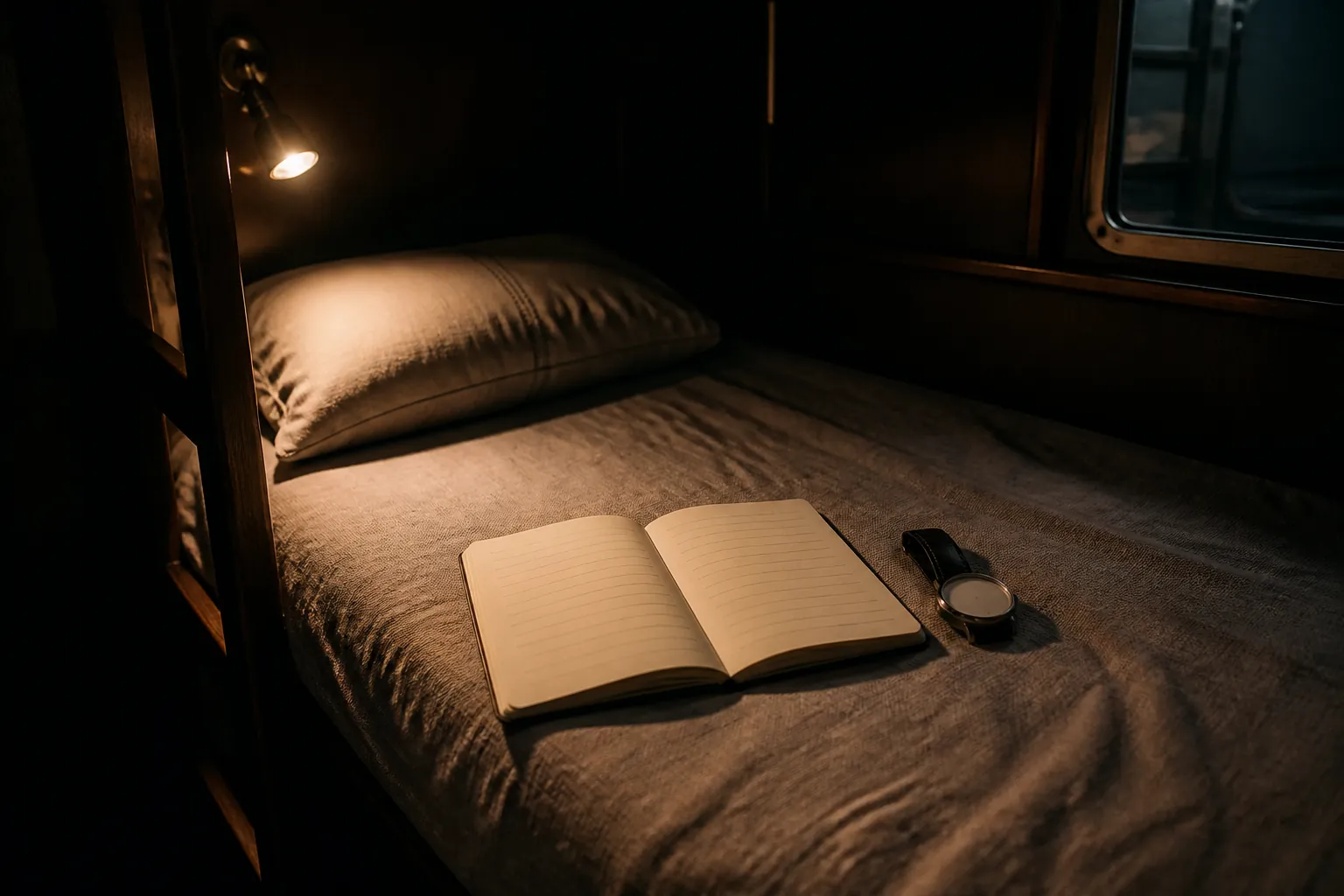
The method has to survive a narrow bed and a dim lamp. If it needs a table, it will fail on the nights that matter most.
- Set a five-minute limit before you open the notebook. When the time ends, you stop.
- Date the page. Do not title the day. Titles invite essays.
- Write four lines, then close the book. Do not reread until you are home.
- If you cannot write, record a voice memo of the same length and say “note” at the start so you can find it.
Skipping a night is allowed once. Skipping two in a row usually means the format is too heavy. Drop to three lines or to voice. Changing format is not a collapse. Pretending you will catch up with a long entry is.
A phone note is allowed if the notebook is in the bag and you will not unpack. Type the same four lines, then stop. Do not scroll the day. The screen will offer photographs, maps, and messages; none of those are the evening mark. If you cannot stop scrolling, put the phone down and use paper, even if the lines are worse.
What can wait until you are home
Transcription, captions, a fair copy, a map redraw: all of that belongs to the return week, not to the bunk. On the road you only need a mark that tomorrow’s similar street cannot overwrite. If a line is ugly, leave it. Awkward handwriting often holds the hour better than a cleaned paragraph.
If evenings are never quiet — children, shared rooms, late arrivals — write on the walk back instead of in bed. The clock still counts. The point is the same day, not the same furniture. For a plan that fits the hours you actually have, write to us through the contact page before you leave.